

Unsung heroes of 2025
Welcome to our Quarterly Update. For this edition, we’ll start with the equity regions that performed well in 2025. They may not be what you think. After that, things get a bit philosophical with Ahmer’s take on how to invest. We end on a cheerful note with Ben’s ideas for what could go well in 2026 and beyond.
Words like ‘best’ and ‘worst’ often get more attention than they should. The headline “Equity markets have worst day in two months” sometimes means “stocks were down 1.5% today”, which usually isn’t something that should spur frantic trading.
2025 defied the norms in many ways, one of which was that most of our attention wasn’t focused on the best performing equity regions. Despite mentions of Artificial Intelligence (AI) and US technology companies being everywhere, US equities weren’t the best performer. The US dollar fell by 7.0% vs. sterling and 11.8% vs. the Euro. That made it harder for US equities to perform well for sterling investors, as the currency returns detracted from the equity market returns.
Stock market returns in GBP
2025 (Total Returns)
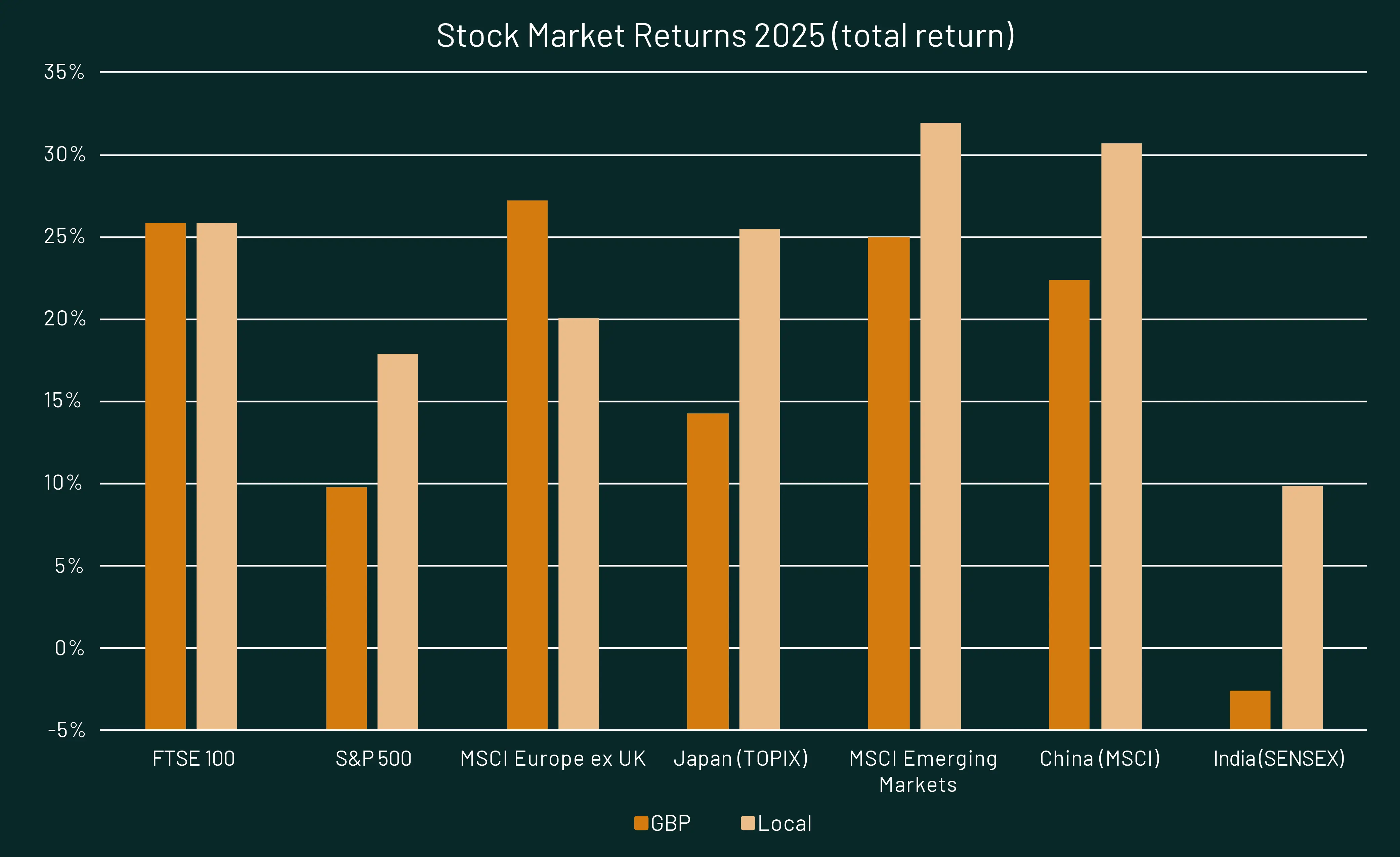
Measured in sterling terms, the best performing equity regions in 2025 were Europe (+27%), UK (+26%) and Emerging Markets (+25%).
There are three key lessons from how they came out on top:


Emerging market equities
While AI is often associated with US equities, just under half of the returns for emerging market equities in 2025 came from AI and related technology themes. Asia is home to several large technology companies that play key roles in AI. Taiwan Semiconductor Manufacturing and Samsung are leading manufacturers of the chips used for AI. Clustered around these manufacturers are companies that provide components and testing services. China has its own technology giants (Alibaba, Tencent, Baidu) that run social media platforms, payment networks, and infrastructure. They’re increasingly incorporating AI into their offerings.
The key lesson from emerging markets in 2025 wasn’t just AI. It was a mix of AI and ‘traditional’ drivers of market growth. These markets started 2025 with low share prices. Remember the narrative of China being ‘un-investable’ in early 2024?
Despite the US imposing tariffs, emerging market economies were resilient. Over the past 30 years, trade between developing countries rose from 9.8% to 24.6%1 as a percentage of global trade. This shift made them less vulnerable to falls in demand from the US and Europe. Average income per person has almost doubled in the past decade, boosting consumption of goods and services.2 In regions without major tech firms, like Latin America, strong commodity prices supported markets.
Lastly, but importantly, there was a hidden boost from a weaker US dollar. It’s common for companies and governments in emerging markets to borrow in US dollars. So, when the dollar’s weaker, less local currency is needed to pay interest on debt. Leaving more money to spend elsewhere!
UK and European equities
Valuations played a key part in the UK and European equity market returns, helped by interest rates and geopolitics. Ten of the top 20 performing stocks in the FTSE 100 Index came from the financial sector. Higher interest rates allowed UK banks to earn better margins on lending and deposits, while default rates stayed low. In Europe, six of the top ten performing companies were in the financial sector.
Geopolitics rarely helps investment returns. But US pressure on Europe to increase defence spending lifted related companies. Firms like BAE Systems and Rolls Royce gained, as did Thales and Rheinmetall in Europe.
Acquisitions were a theme for the year, due to inexpensive valuations. Packaging firm DS Smith was bought by International Paper for £7.8 billion. Direct Line Group was bought by Aviva for around £3.7 billion. Even failed bids can raise share prices through interest and speculation. Firms like Anglo American, Rightmove and BP all saw talk of offers over the year.
Lessons for the future
Some of the best investment opportunities often lie beyond the headlines. Investors who looked past US equities were rewarded in 2025. Valuations can’t predict returns over 1-2 years, but they help shape longer-term results.
The best performers of 2025 show that valuations matter. Europe, the UK and emerging market equities began the year with much lower valuations than US equities. They then beat expectations and delivered strong returns. When you invest in areas that have lower valuations, the returns aren’t always steady. It takes patience and a strong investment process to get the benefits.
We’re big believers in diversification – across equities, bonds and alternatives we use in our investment strategies. It’s important to look at the numbers rather than the commentary. Our investment process is driven by data, which helps us avoid behavioural biases. If everyone’s talking about something, we become more familiar with it and might be more inclined to invest. But some of the best opportunities are those that aren’t covered in the press.
1 World Trade Organisation, “Thirty years or trade growth and poverty reduction”. 24 April 2024.
2 International Monetary Fund, “World Economic Outlook” October 2025

More from 7IM



I confirm that I am a Financial Adviser, Solicitor or Accountant and authorised to conduct investment business.
If you do not meet this criteria then you must leave the website or select an appropriate audience.