

Which “job” is AI coming for?
Have you heard about this AI thing? It certainly seems important, and there’s certainly a lot of money being spent on it – allegedly more than $2 trillion worldwide in 2026. But it’s not really clear what the result of all that investment is going to be. Nobody is quite sure what it’s going to do to the economy.
Some people say it’s going to cause mass unemployment. Others are suggesting that that’s the best-case scenario. Often, that uncertainty manifests as: if AI can do your job, you no longer have a job.
But it’s not quite that simple.
Most modern jobs aren’t a list of instructions to be followed. The purpose of any given job is often more complicated than the employee or the employer realises. And the skills used are often less obvious than they first appear. A “job” bundles up many different things, and they don’t all appear on a checklist at the end of the day.
Because of this, automating a task rarely results in replacing the person who used to do it.
Let me give you three different historical examples of automation, where in all cases, the outcome wasn’t as predicted by pessimists at the time.
More of the rest: commercial dishwashers
Commercial dishwashers revolutionised one of the least enjoyable tasks at restaurants and hotels. But stick your head into (almost) any restaurant kitchen and you’ll still see a kitchen porter/runner1.
They stack the dishwasher, set it running and then it’s on to other tasks: clearing plates, cleaning service areas, prepping food, assisting chefs and, then yes, unloading the dishwasher. Cleaner plates delivered more frequently meant more people eating, which meant more of everything else, i.e. clear a bottleneck and overall capacity increases!
Missing the point: doormen
Author/advertising guru Rory Sutherland talks about the “doorman fallacy”. Stand outside a fancy hotel in the 1960s and a doorman would open the door for you. Game over when the automatic door was invented, surely?
It turns out the door wasn’t the job. For a hotel, having a doorman outside broadcasts security, local knowledge, coordination and reassurance. For a guest, it’s about being treated as special by a representative of where you’re staying. It’s an early welcome, adding personality and familiarity into a strange place. Try looking that up in the job description!
Skills, not products: blacksmiths
At the start of the twentieth century, horses were the main form of transport. So, there were a lot of blacksmiths, to keep them in shoes.
Then, Henry Ford and his peers got going. Cars, not horses. Wheels, not hooves. Most blacksmiths saw the writing on the wall.
United States employment (thousands): blacksmiths vs car factory workers, 1900–1950.
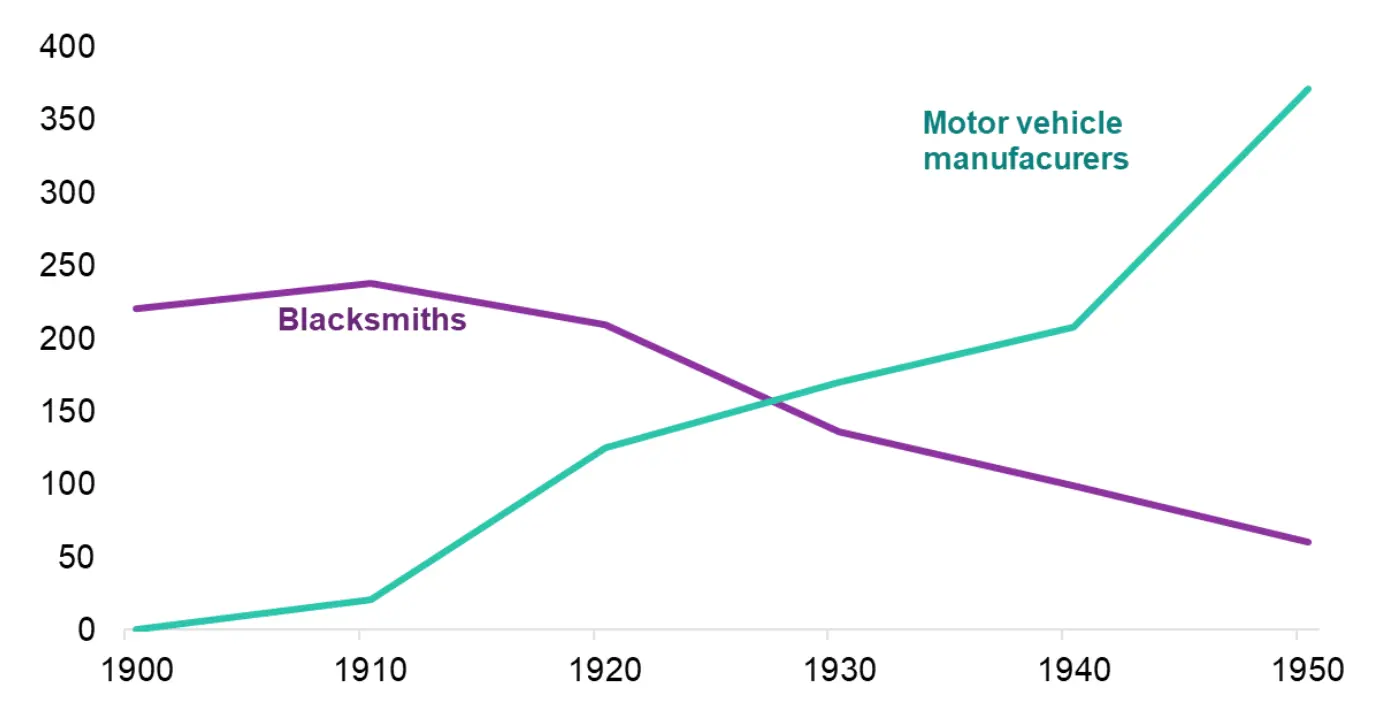
Source: Bureau for Labour Statistics/PiperSandler/7IM
But they were reading it wrong.
Blacksmiths believed that their job was putting horseshoes on horses. I mean, it had been for hundreds of years! No horses, no job. But the skill was working metal, repeatably and reliably. 250,000-odd blacksmiths in 1910 were replaced by 350,000 car factory workers by 1940. But many of these were the very same people!
“But AI is different”
Maybe. Maybe this will be the time where technological advances create mass unemployment. But I’m not so sure. Look at radiology – the medical specialty which interprets images, recognises patterns and produces reports.
That “job” is right in the sweet spot for AI.
In fact, radiology has been using AI for longer than almost any other profession. The first computer aided detection tools appeared more than a decade ago, and in the US, three quarters of ALL approved AI medical devices are for radiology. These tools increase efficiency by an average of 15-20%.
So, has demand for radiologists fallen by that amount?
No – we now need more radiologists than ever! The UK currently needs 30% more radiologists just to meet current demand. The US is a little better but is still seeing double-digit vacancy rates.
AI sped up some tasks: triage scans and report drafting. But that’s not the whole job. More scans are done, more conditions detected, more followup required, and more human judgement demanded.
In radiology, a cleared bottleneck created more work (like the dishwasher). And the scan analysis wasn’t the whole of the job (like the doorman). In fact, the skill is the judgment, not the report-writing – and there’s more demand for judgment than ever (like metalworking).
Tasks might well be done by AI. But jobs are done by people.
1 Between 2005 and 2008, B.Kumar for example

More from 7IM



I confirm that I am a Financial Adviser, Solicitor or Accountant and authorised to conduct investment business.
If you do not meet this criteria then you must leave the website or select an appropriate audience.