Monthly commentary
October 2026: FOMO to Solow
For most of the four years since ChatGPT launched, AI has been a FOMO trade. Investors – retail and professional – all asking the same questions. ‘Who’s got the best model?’ ‘Who’s buying the most chips?’ ‘Who’s building the biggest data centres?’ And ’do I own enough of all of them?’
In October, however, a new question started to work its way around - ’Who’s going to keep paying for all of this?’
The hunt for answers made things a bit uncomfortable towards the end of the month. Alphabet lost roughly $500bn of market value in a single day. Intel lost more than $120bn the next. Corporate credit markets got nervous too.
The big tech companies have blown through the huge cash piles accumulated in the last decade (see chart of the month). And moving from being a big spender to a big borrower isn’t pretty, especially when the return on all that spending is difficult to see.
So, from FOMO to Solow.
Robert Solow was an economist who observed in 1987 that “you can see the computer age everywhere but in the productivity statistics.”
Email is a great example. It’s obviously better than sending a letter for most business purposes. Email is quick, it’s cheap, it’s more flexible.
But the economic benefit is weirdly difficult to measure. Companies spent fortunes on computers and networks, yet the resulting improvements in communication, collaboration and convenience didn't neatly appear in the productivity statistics.
AI faces the same problem. If Copilot or Claude turns a two-hour task into a 20-minute one, the employee doesn't necessarily produce six times as much. Perhaps they check their work more carefully. Explore another idea. Or simply leave the office less stressed and slightly earlier.
All potentially valuable. All difficult to measure.
And that's becoming a problem. Businesses are being asked to spend more on AI before many can clearly demonstrate the return on what they're already spending. Meanwhile, the AI providers need more chips, more data centres, more electricity and, increasingly, more financing.
The costs are exceptionally easy to measure. The benefits aren't.
That's Solow's paradox. And if I were running one of the big AI labs, I'd be spending less time telling customers what AI can do and more time helping them prove what it has done.
Because if customers can prove AI pays, they'll keep paying.
Chart of the month: Where’d the money go?
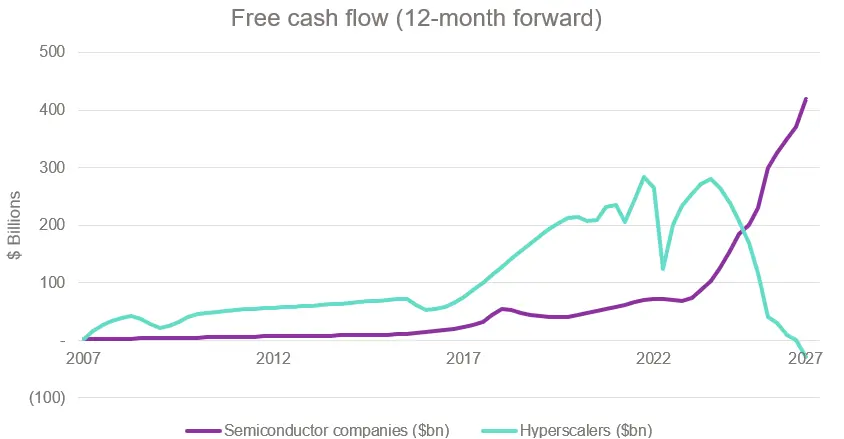
Source: LSEG. Hyperscalers - Amazon, Alphabet, Meta, Microsoft, Oracle. Semiconductors - Nvidia, Micron Technology, Broadcom, Applied Materials Inc. 12-month forward free cash flow is a forward-looking estimate, based on analyst forecasts of the year ahead.
The world has flipped. It used to be the big software companies who made money like it was going out of fashion. After all, additional users are incrementally low to service, but can return higher levels of profitability. Now, money is being ploughed into data centres, which if you’re on the receiving end of the hyperscaler spend, it’s resulting in a big payday.
October Markets Wrap
October proved the importance of diversification. After a relatively quiet start to the month, concerns around the sustainability of AI-related capital expenditure weighed on technology heavy equity markets. Investors became increasingly focused on the scale of spending among US hyperscalers and the pressure of turning that spend into revenue generation. Alphabet was at the centre of these concerns after acknowledging that increased use of AI agents was beginning to affect its traditional search business, causing its stock to lose over $500bn of market capitalisation, after a mixed set of reported earnings.
UK and European equities proved more resilient, finishing the month higher. Their lower exposure to AI-related companies, combined with a greater weighting to the energy sector, provided a boost as higher oil prices contributed to a strong earnings period for the large oil companies within the UK market.
Fixed income proved an important source of diversification after a volatile period for the asset class. Government bond yields declined across several major markets, with the US 10-year Treasury yield dropping below 5%. UK gilt yields also retreated from their summer highs, with the much anticipated first Budget for Andy Burnham having a limited market impact.
Market movers
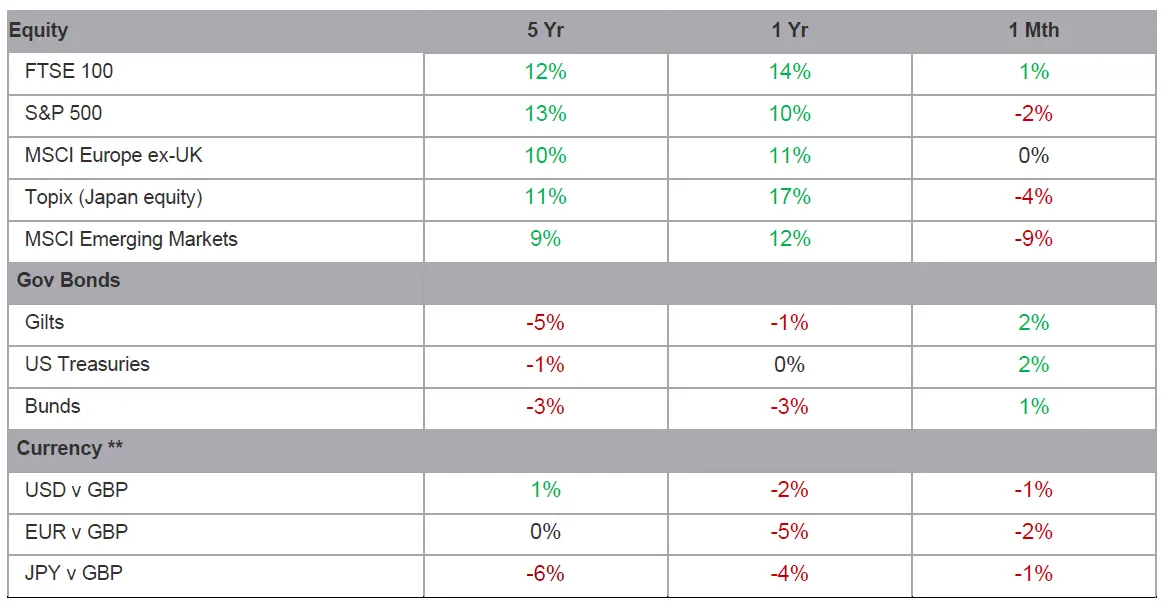
Source: Factset. Quoted returns are in GBP. Returns over 1 year are annualised. As at 31 October 2026.
** Currency returns are based on FX rates at midday London time
What we’re watching in November
• 4 November – US Midterm Elections - we don’t think they matter too much, we’ll stay tuned
• 5 November – Bank of England Monetary Policy Committee meeting
• 16 November – possible Anthropic IPO. Real acid test of market love for AI
• 17 November – NVIDIA earnings; let’s see how selling picks and shovels is going
• 19 November – Walmart earnings; let’s see how normal US retail is doing
More from 7IM