

Alternatives: The same old song
Most of the hit songs of the 1960s were made by the same individuals.
We're not suggesting that The Beach Boys, The Mamas and the Papas, Sonny & Cher, and The Monkees were actually all the same people (although the haircuts did look similar). What we mean is that in the recording studio, it tended to be the same group of Los Angeles session musicians, The Wrecking Crew, providing the underlying tune. This relatively unknown collection of musicians was hugely influential, part of no less than 42 UK and US Number 1s.
The portfolio equivalent of The Wrecking Crew is "alternatives".
Lots of "alternatives" strategies end up being the same as other parts of the existing portfolio – just wearing a different outfit.
Some culprits: property, in the form of Real Estate Investment Trusts, ends up being sensitive to the equity market and to interest rates. Infrastructure? Same. Listed private equity? The clue is even in the name. Aircraft leasing, music royalties, crypto. Same, same, same (only worse).
Portfolios end up saying they're doing something new and different but end up hiring the same band. And when the market music stops, there's no hiding place in alternatives.
When Traditional Diversifiers Failed: Equities and Bonds in 2022
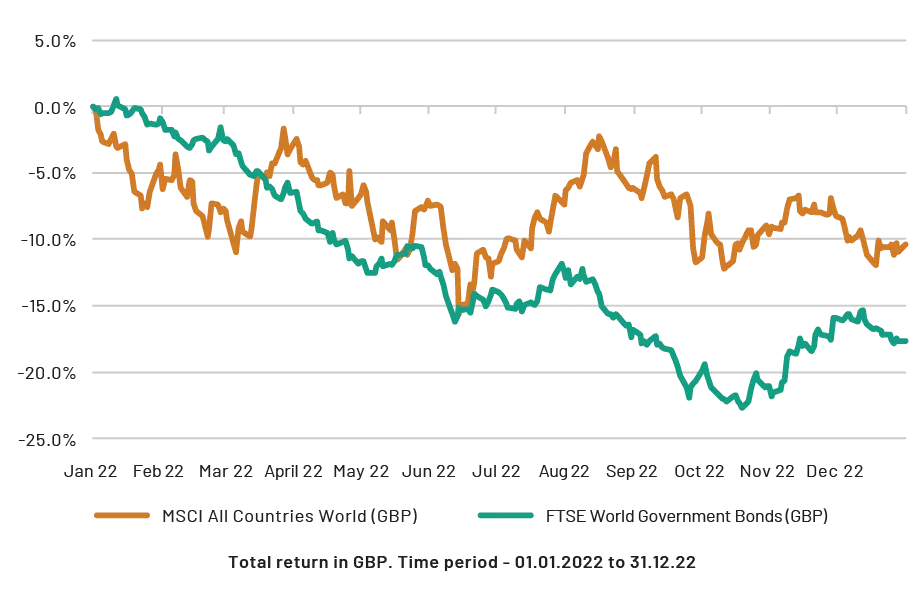
Source: LSEG Workstation.
What makes a true alternative?
At 7IM, we've always been a bit fussier.
The 7IM definition of a true alternative is something where its return isn't driven by the same factors as equities and bonds. We want music from a different continent to Los Angeles.
So rather than buying up buildings, telephone masts or song rights, we achieve diversification from a set of liquid, behaviourally based strategies that are designed to make money independently of the rest of the portfolio.
We blend lots of these different diversifiers together (6-10 positions, typically) to create an alternatives portfolio that really sings.
We've been running Alternative portfolios in this way for a decade, and it's become one of our strongest skillsets.
Bringing it all together
We've now reached the stage where we can put different products in a more efficient parcel to provide advisers and their clients with diversified, more efficient, and lower cost exposure to alternatives:
- Core Quantitative Investment Strategies Fund (Core QIS)
- Diversified Alternative Strategies Fund (DAS)
The two funds play slightly different roles in the portfolio.
Core QIS
Core QIS is the rhythm section – steady, contained, controlled.
Core QIS provides a more defensive approach from a focused set of strategies, with an expected similar level of risk to a moderately cautious portfolio.
DAS
DAS is allowed to have the odd solo riff and be a little more nimble across the stage.
A broader mix of strategies, a little more active management and the potential for a little more upside.
Different instruments, but the same goal of improving portfolio diversification.
So, what's actually inside?
A handful of well-understood, well-researched ideas that evidence shows can work across decades of market cycles.
Trend following, value, and carry – to name just a few – have all been part of financial markets for decades, and we gain exposure to them in multiple asset classes at once, targeted over different time periods.
At any given moment, one strategy may be struggling. But the way we blend them means that others should be doing OK, and maybe even outperforming.
And none of them should care what's happening in the FTSE 100, S&P 500 or the US Treasury market.
Open architecture
There's a clever bit behind the curtain, too.
Rather than getting all our tunes from a single record label, the funds are open architecture. This means that we can pick strategies from a panel of the world's big banks (J.P. Morgan, Goldman Sachs, Morgan Stanley and Société Générale), choosing whoever plays each part best.
And because all the rebalancing happens inside the fund, advisers get the whole orchestra in a single, liquid, daily-priced holding.
Less admin, less trading, fewer moving parts on your side.
The role within a portfolio
Our approach has always been about what each instrument adds to the whole portfolio, not how impactful it can be on its own.
These funds bring together our Alternative strategies into dedicated building blocks for the 7IM alternative expertise you can't get anywhere else.
The funds are included in 7IM’s Active and Blended MPS. Within our fund ranges, they are part of the 7IM Funds and 7IM Asset Allocated Passive Funds (AAP). The costs for the MPS and Funds have fallen by 0.02% to 0.05%, depending on the strategy. And whilst it might look small on the surface, it’s for some models it represents a 10% saving.
The opinions herein are those of the author and don’t constitute investment advice or recommendation. The past performance of investments is not a guide to future performance. The value of investments can go down as well as up and investors may get back less than they originally invested. Any reference to specific instruments within this article doesn’t constitute an investment recommendation.

More from 7IM



I confirm that I am a Financial Adviser, Solicitor or Accountant and authorised to conduct investment business.
If you do not meet this criteria then you must leave the website or select an appropriate audience.