

Monthly commentary
August 2026: Lagging through the Dog Days
The ancient Greeks and Romans thought that the hot, humid weather throughout August was caused by Sirius – the “Dog Star” – being in the sky at the same time as the Sun. In reality, August heat owes more to "thermal lag" than to the Dog Star. The Earth slowly absorbs warmth during spring and summer, then releases it over the following months. It's why the sea is often warmer in October than during the summer holidays.
As we head into the final third of the year, there are a few economic and financial lags worth watching.
The first is the data centre spending lag. Right now, companies that build data centres – and the bits that go in them – are recording record sales and have backlogs of orders stretching years into the future. And the companies which are placing those orders, including Amazon, Microsoft, Alphabet, Meta etc. are also recording record sales.
The question many people are asking is: “What will happen when the orders dry up?” That’s a good question; but a better one is: “How long is the lag before orders are cancelled?”
It’s not an easy question to answer. It would mean huge, fast-growing tech businesses were downgrading their own future prospects. It would also mean that the billionaires running them would have to admit they were wrong. When does the commercial argument outweigh the billionaire’s ego? The lag could be a lot longer than people realise.
The second lag is food price inflation. The closure of the Strait of Hormuz has affected fertiliser supplies during the key growing period of 2026, with the effects of El Niño adding another curveball. We know pressure is building, but we don’t know by how much. By the time it reaches supermarket shelves, it’ll feel sudden. In reality, the causes will have been baked in months earlier.
The third lag relates to human health. Weight-loss drugs are now widely used and available across the developed world. Average BMI levels in the US are falling for the first time in decades.
The ripple effects are only just beginning. The first-order effects are obvious. For example, households with someone taking GLP-1 medication buy 5–6% less food, and spend around 10% less in restaurants, prompting food companies to pivot to smaller portions.
The next ripples are more complicated. Do GLP-1 users prefer lifting weights to cardio? Do they buy an entirely new wardrobe? Do they travel more or less?
We can’t predict when these lags will hit. But we can prepare to react – or not – when they do.

Chart Table of the month: Bond maths matters
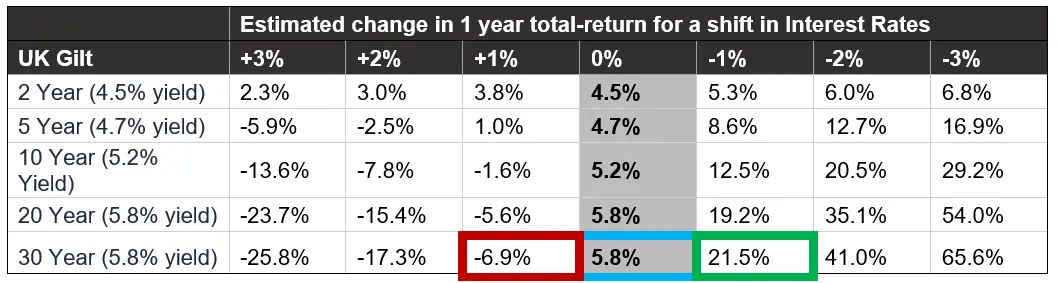
As interest rates fall, the price of a bond goes up, when interest rates rise, bond prices fall. Simple? Not so fast. Bonds have a quirk that's worth understanding. Its technical name is convexity, it means a move in rates doesn’t translate to the same move in price.
Roughly speaking, the higher the starting yield, the more return you get if rates fall. A 30-Year UK government bond currently pays around 5.8% a year. If interest rates stay unchanged, you’ll make 5.8% by the end of 12 months (blue box). If interest rates rise by 1%, you’d see a return of -6.9% (red box). But if interest rates fall by 1%, that return turns into a 22% gain.
If you rewind to 2022, a 30-year bond had a yield barely more than 1%, with interest rates at a record low of 0.1%. Not much in the way of yield, and very little chance of a further fall in rates to boost returns. A lot of risk for no reward.
Today, the odds are more in your favour, and you’re being paid to wait. For cautious investors, that’s a much better position.
Source: 7IM / LSEG Workstation. Data as at 02.09.2026. Total return includes interest
August markets wrap
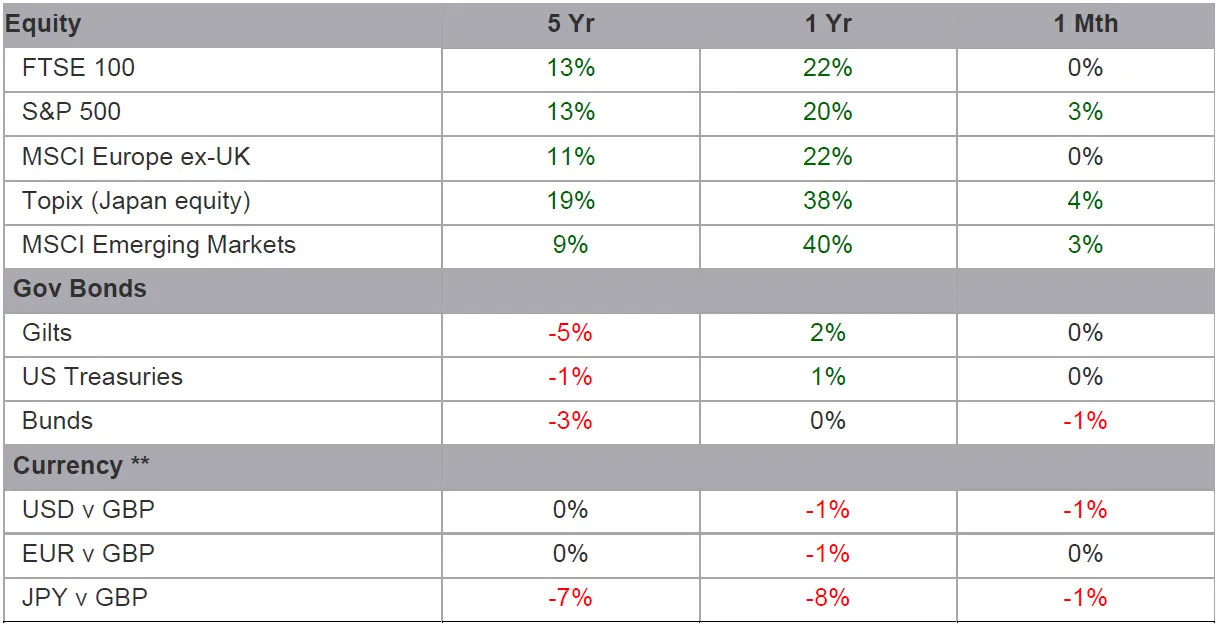
Following a poor July, technology and AI related stocks rebounded in August, supported by strong earnings from some of the biggest spenders on AI. The Magnificent Seven companies, which had struggled throughout 2026, finally bounced back as concerns about capital expenditure eased following reports of strong AI demand and continued revenue growth.
These companies still dominate the US market, which returned around 3% in sterling terms following this positive earnings season. Emerging-market equities also benefited from the technology-related rally, with Taiwan adding 7% to an already stellar year. Elsewhere, despite a strong month for energy-related companies, the UK and Europe were held back by their relatively limited exposure to technology stocks, finishing the month broadly flat.
Bond markets struggled in August, although they remained in positive territory over the previous 12 months. Higher oil prices reignited inflation concerns and pushed government bond yields higher across the world’s major developed economies. Central banks, including the Federal Reserve, the Bank of England and the European Central Bank, met during the month but left interest rates unchanged.
The murky inflation outlook, combined with continued pressure on oil prices, led central banks to adopt a wait-and-see approach as they assessed the potential economic impact of disruption to energy markets. Rising yields weighed on longer-dated government bonds, while corporate bonds proved more resilient, supported by the strong corporate earnings season.
Market movers
Source: Factset. Quoted returns are in GBP. Returns over 1 year are annualised. As at 31 August 2026.
* Currency returns are based on FX rates at midday London time
What we’re watching in September
- 10 September – US 30 Year Treasury auction. Given the pressure on borrowing yields, it’ll be interesting to see how many bidders show up and what yield they’ll accept
- 16 September – Federal Reserve monetary policy decision; will Warsh have to hike to stay credible?
- 17 September – Bank of England monetary policy decision; no action likely ahead of budget at the end of October
- ??? September – possible Anthropic IPO.
More from 7IM



I confirm that I am a Financial Adviser, Solicitor or Accountant and authorised to conduct investment business.
If you do not meet this criteria then you must leave the website or select an appropriate audience.