

Monthly commentary
July 2026: The museum of the future
If you'd asked investors which developed economy was most likely to surprise on the upside in 2026, Germany probably wouldn't have topped many lists.
The narrative has been well established. An ageing population, struggling manufacturing sector, expensive energy, bureaucracy and a stock market increasingly overshadowed by America's technology giants. Germany was seen as Europe's industrial museum rather than its innovation hub.
Yet something interesting is happening beneath the surface.
Instead of being late to the Artificial Intelligence (AI) party or struggling to know who’s currently in charge (looking at you 10 Downing Street), the German government has been adding billions of Euros to its economy.
Germany's landmark €500bn Infrastructure and Climate Neutrality Fund is moving from political announcement to economic reality. The programme is designed to revitalise the German economic landscape over the coming decade. The plan includes upgrades to railway infrastructure, education, housing and importantly defence.
The hope is that long-term planning, public investment and economic certainty will bring in private capital and address some of the bottlenecks that have constrained German growth for years. Progress has been slow, but some green shoots have appeared in the form of entrepreneurial spirit.
Business creation has soared, with 1600 startups already launched in 2026 (vs just 600 in 2025) and a 44% rise in venture capital investment in the region.
A glimmer of hope shines through the windows of the German Museum, but it goes to show what an eye on the future can do for an economy covered in dust.

Chart of the month: Cash is King
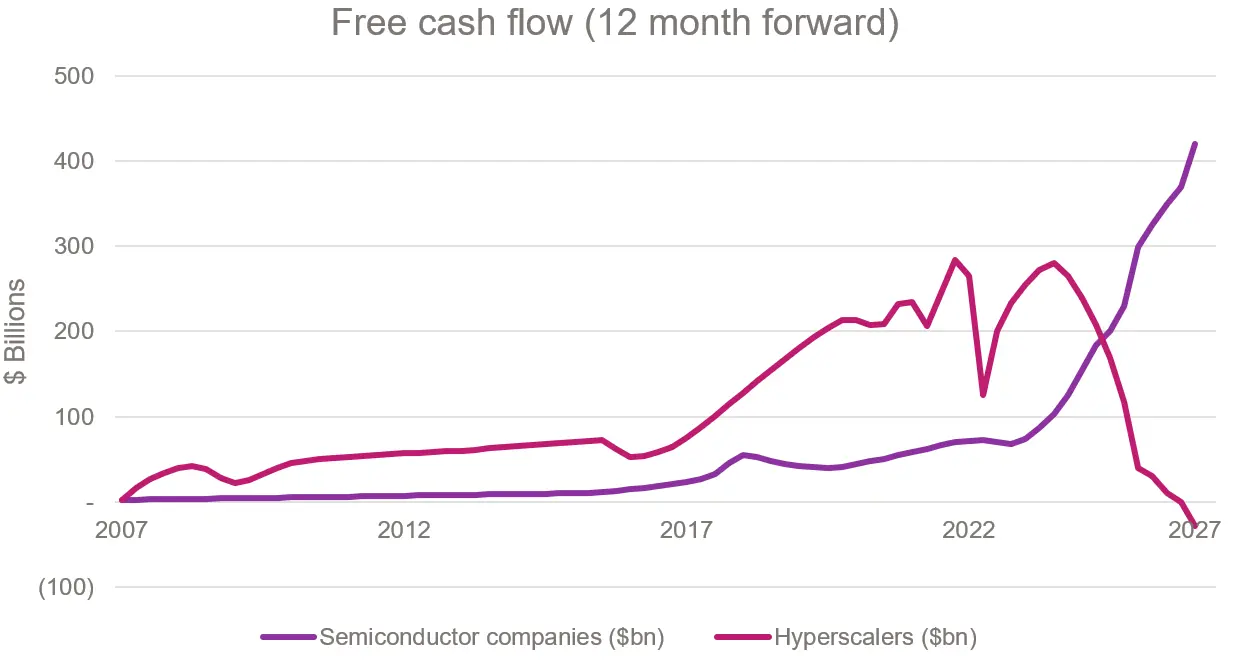
Source: LSEG. Hyperscalers = Amazon, Alphabet, Meta, Microsoft, Oracle. Semiconductors = Nvidia, Micron Technology, Broadcom, Applied Materials Inc. 12 forward free cash flow is a forward-looking estimate, based on analyst forecasts of the year ahead. As at 30 June 2026.
Free cash flow is the cash a company has left over after paying for everything it needs to keep its business running and growing.
Think of it like your own bank account. After your salary lands and you've covered the essentials and any big necessary purchases, whatever’s left in your account is yours to do as you please.
You could save it, invest it, or even treat yourself.
Historically, the large hyperscalers (Meta, Alphabet, Microsoft) have been in the saving camp. They scored strongly on cash flow metrics, as their business models didn’t need significant cash spend to keep them running and profitable.
That picture has changed. In pursuit of their AI ambitions, these cash rich technology giants have spent increasing amounts of capital on data centres, computing infrastructure and development. As a consequence, free cash flow metrics have come under pressure, prompting investors to pay closer attention to how these companies intend to pay for their long-term AI strategies and, crucially, when those investments will begin generating meaningful returns.
With one big spender, there’s always a winner on the other side. That winner so far has been the semiconductor businesses that provide the vital infrastructure for AI development. These are the companies making the semiconductors, memory, and storage – the physical stuff AI runs on. Companies like Nvidia, Micron Technology and Broadcom shown in the purple line, are now top of the leaderboard for cash flow metrics.
July markets wrap
July was a volatile month for financial markets.
Geopolitical tensions in the Middle East resurfaced as the ceasefire broke down, pushing oil prices briefly back towards the widely anticipated $100-per-barrel level. However, unlike the March market reaction, equity markets were relatively resilient, with many finishing the month only modestly lower.
As has often been the case this year, performance varied considerably across both regions and sectors.
The semiconductor sector experienced some of the most aggressive declines globally, as investors questioned the sustainability of the exceptional earnings generated by several leading chip manufacturers. This was particularly evident in Asia, where equity markets have significant exposure to the sector. The Korean market fell by almost 30% during the month before staging a strong recovery on the final trading day.
Weakness in artificial intelligence-related stocks also weighed on the technology-heavy US market. While the S&P 500 delivered a broadly flat return over the month, underlying market performance revealed a notable divergence. The small and medium sized companies within the S&P 500 outperformed the market-capitalisation-weighted counterpart, highlighting an ongoing rotation away from the highly valued technology companies that have driven much of the index's recent performance, into the unloved names.
Unsurprisingly, markets with lower exposure to the technology sector were top performers. The FTSE 100 was the strongest performing major equity index, benefiting from higher oil prices and limited exposure to technology stocks.
Fixed income markets also experienced a busy month, with investor attention focused on central banks and the outlook for interest rates. Rising oil prices renewed concerns over inflationary pressures, leading markets to price in a greater likelihood of interest rate increases. Despite these inflation driven concerns, policymakers in the US, UK and Europe left interest rates unchanged. Central banks adopted a cautious, data driven approach, preferring to wait for greater clarity on the duration and future implications of the ongoing conflict in the Middle East before adjusting policy.
Market movers
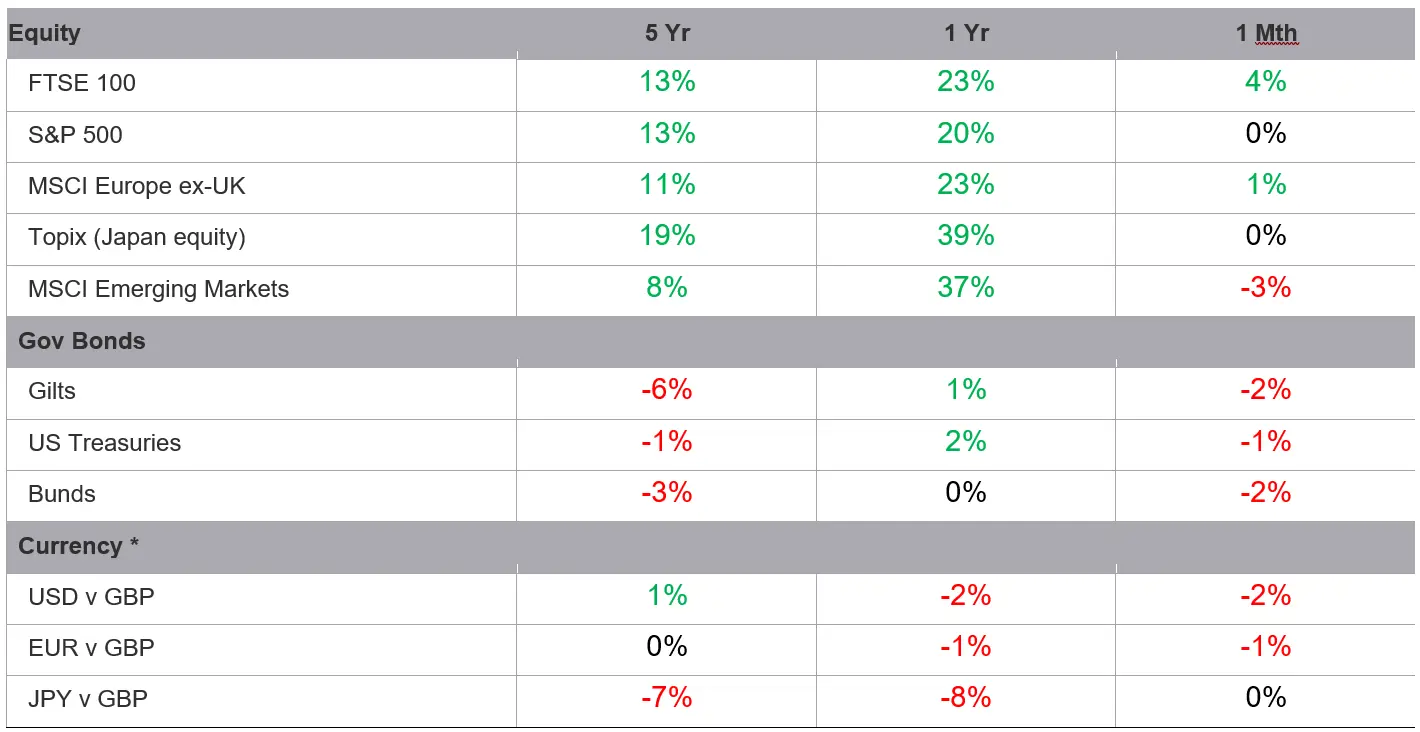
Source: Factset. Quoted returns are in GBP. Returns over 1 year are annualised. As at 31 July 2026.
* Currency returns are based on FX rates at midday London time
What we’re watching in August
12 August – US Consumer Price Index (CPI) – will energy prices continue to cause inflation headaches for the Federal Reserve?
20 August – Walmart results. Walmart's results will provide a valuable gauge of the health of the US consumer, which has remained resilient throughout 2026.
26 August – Nvidia results. Arguably the most important earnings release of the month and a major test of AI infrastructure demand.
More from 7IM




I confirm that I am a Financial Adviser, Solicitor or Accountant and authorised to conduct investment business.
If you do not meet this criteria then you must leave the website or select an appropriate audience.