

Should you invest all at once or drip feed into the market?
“How quickly should I invest?"
It’s one of the questions we’re asked most often.
There could be any one of a million reasons – someone has sold a house or a business, taken a pension lump sum, received an inheritance – and suddenly there's a meaningful pile of cash sitting in a current account, causing a psychological problem.
People are left in a horrible dilemma. They know they need to invest. The idea of missing out on gains, the money just sitting there doing nothing, inflation eating away at it?
Not appealing.
But at the same time, the RISK is horrible. What if the market falls by 10%? Or more? How stupid would it feel to see that cash pile dwindle away?!
Investing feels awful, but so does doing nothing.
So, what to do?
Many people end up doing something which the finance industry calls cost averaging; more commonly known as drip-feeding. Don’t invest all at once. Instead put some in now, some in later using a staged approach.1 This spreads the risk of something negative happening the instant you’ve invested your money, gives you a bit of breathing space and a buffer.
It’s the financial equivalent of NOT ripping the plaster off, but doing it gradually, in a warm bath. But does it work?!
Well. It depends on what you mean by work. This is a wonderful example of theory vs. practice, economics vs psychology, and academia vs. the real world. The rational choice isn’t necessarily the right one.
The numbers:
In general, markets go up over time - roughly at a rate of two positive years to every negative one (although it rarely happens exactly like that, see the chart below).
Annual Returns of MSCI World since 1990: 66% up years, 34% down years
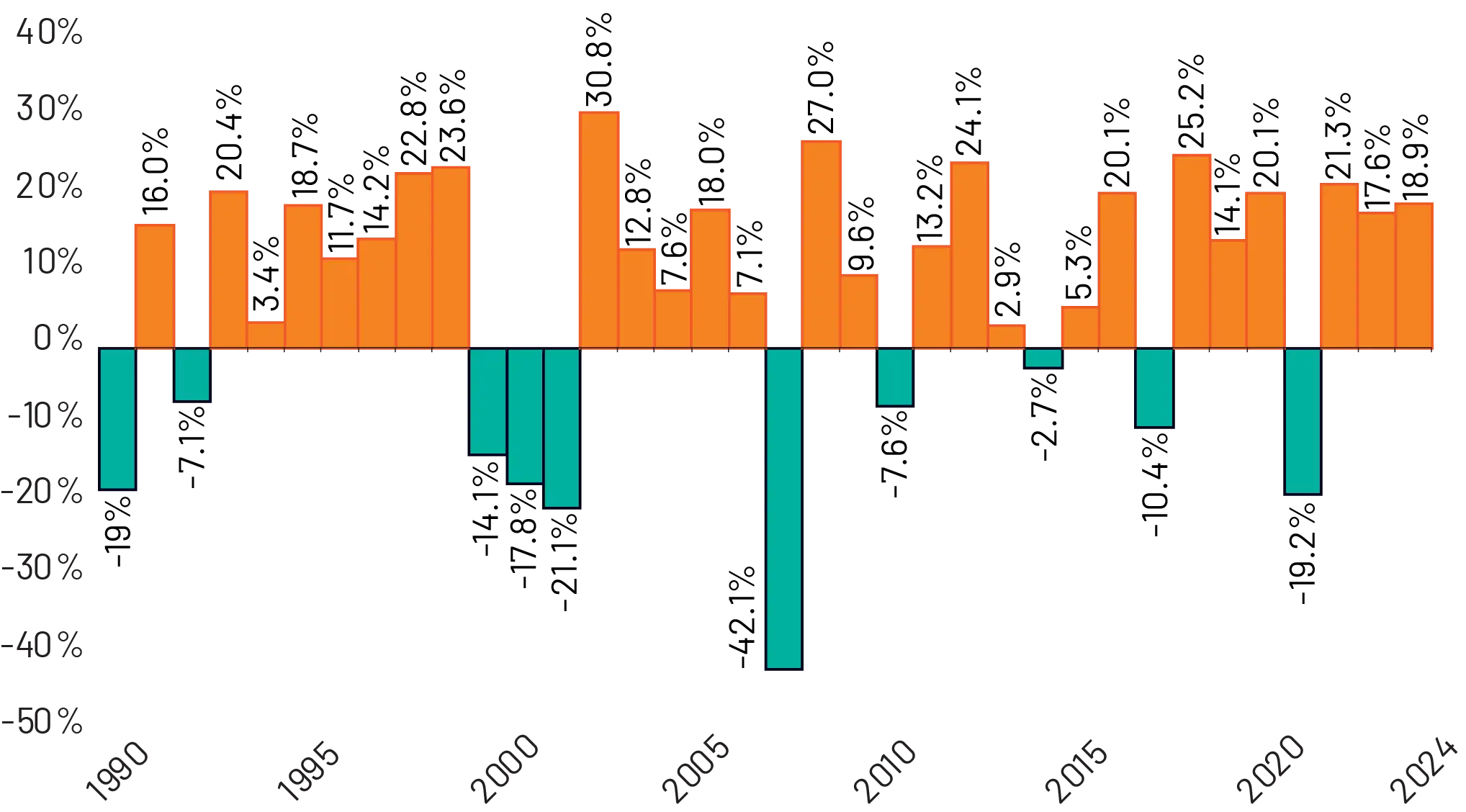
Source: Factset
If you invest your cash pile all at once, more often than not, you’ll be in positive territory within 12 months; when we looked at a classic 50/50 equity and bond portfolio, we found it lost money 18% of the time on a one-year view.2 The average return was 9%.
Which sounds… OK in theory. A one in five chance of “losing” money. At a casino, you’d take those odds all night. But at a casino it’s not (hopefully) a once-in-a-lifetime sum on the table.
The problem is that drip-feeding doesn’t really change the picture. If you stage in over six months, you lose money… 18% of the time. Exactly the same! And the average return was 8%. So dripfeeding costs you a full percent of performance, without really changing your odds of a loss.
Other studies find the same thing. Investing all at once beats drip-feeding most of the time, and the drip-feeding strategy very rarely offers any real protection from a falling market.
But.
We think drip-feeding is a great idea.
We think it makes sense for most, if not all investors. How can we say that honestly?
It’s because the question "how quickly should I invest?" isn’t really a maths question.
It's an emotional one.
Economists say invest all at once. But humans – irrational, emotional awake-at-3am humans – say, "what if I’m unlucky ". And it’s humans who stress. Humans who decide whether to bail out. Humans who stay in cash to avoid losing money and are still there six years later.
The power and control of drip-feeding helps people avoid this mistake. Rather than worry about being exactly optimal, it helps us get them roughly right. It gives someone a way to start, when starting is the hardest part.
It might cost you around 1% to invest gradually over time. But refusing to invest AT ALL costs far more than that. Each year you don’t invest makes it harder to finally get going. Not investing at all is the worst outcome. Investing and then backing out is nearly as bad.
So, when someone asks me, "how quickly should I invest?", the answer is about psychology, not economics: whatever gets you invested and sleeping at night. That usually comes down to a conversation, not a calculator…
1 A common approach is investng one third in now, one third in three months and one third in six months, but there are others
2 A 50% FTSE All-Share Total Return Index and 50% FTSE Actuaries. All Gilts Total Return Index, with data back to 31/01/1975

More from 7IM



I confirm that I am a Financial Adviser, Solicitor or Accountant and authorised to conduct investment business.
If you do not meet this criteria then you must leave the website or select an appropriate audience.