

Monthly commentary
September 2026: Final quarter special. What’s on people’s minds?
Every month, Bank of America ask professional fund managers what’s keeping them awake at night.
| 2026 | Bank of America Fund Manager Survey “Top Tail Risk” |
|---|---|
| January | Geopolitical conflict |
| February | AI bubble |
| March | Private Credit |
| April | Geopolitical conflict |
| May | Inflation |
| June | AI bubble |
| July | AI bubble |
| August | Bond yields |
To be honest, you could just ask the entire population. Most of the time, professional fund managers are basically worried about all the same things that everyone else is (the possible exception in the list above is “private credit”).
We thought it was worth giving our view on these concerns, which clients might bring up as we go through the last three months of the year.
We actually think that the balance of risks is relatively even (as much good as bad). It just sometimes doesn’t feel like it!
Is AI a bubble?
The hottest topic is still AI. Every week there’s a new headline which is amazing or terrifying or both at once.
Now there’s no sense in suggesting that AI isn’t important. All of the top ten companies in the global index below all have some flavour of AI about them; whether using, developing or building it.
MSCI All-Countries World Index – Top 10 Stocks
| Company | Country | Value (USD)* | Weight in Index | Sector |
|---|---|---|---|---|
| Nvidia | USA | $4,349bn | 4.53% | Information Technology |
| Apple | USA | $3,551bn | 3.70% | Information Technology |
| Microsoft | USA | $3,536bn | 3.69% | Information Technology |
| Amazon | USA | $2,247bn | 2.34% | Consumer Discretionary |
| Alphabet A | USA | $1,769bn | 1.84% | Communication Services |
| Taiwan Semiconductor | Taiwan | $1,735bn | 1.81% | Information Technology |
| Broadcom | USA | $1,587bn | 1.65% | Information Technology |
| Alphabet C | USA | $1,539bn | 1.60% | Communication Services |
| Meta Platforms | USA | $1,502bn | 1.56% | Communication Services |
| Micron Technology | USA | $1,196bn | 1.25% | Information Technology |
*Float-adjusted market capitalisation in financial jargon
A new technology with vast potential, huge risks, many unknowns, and billions backing its development. It’s easy to see why people are concerned.
So is there a bubble?
Importantly, today's AI market is different from the dot-com boom of 2000, which is the comparison most people make. In the 1990s, many internet companies achieved high valuations despite having little profit, limited revenue and unproven business models. While that is true of some companies today, it is not true of the major players in AI.
Most of the leading, largest companies, including Nvidia, Microsoft, Alphabet and Amazon, are already established, profitable businesses with substantial cash flows.
Of course, these companies are investing heavily in AI. But if that spending slows, profits could soon grow again. That does not remove the risk of market swings or a correction. However, it does mean the foundations are much stronger than those of many speculative companies during the dot-com era.
It’s easy to worry about a crash, but that doesn’t mean one is imminent. We think that the market is behaving relatively rationally about AI, and that the healthy dose of caution about the big spenders is actually keeping a bubble from inflating.
Rising bond yields and government debt
Government bond yields have risen sharply around the world in recent years. Bonds usually only grab attention when there are concerns. After all, a headline saying, "Borrower successfully repays loan" is unlikely to generate many clicks.
Put simply, investors are asking for higher returns to lend money to governments. Some of the reasons behind higher bond yields matter more than others. Stronger-than-expected economic growth (yes, even in the UK!), and interest rates that are higher than we've become used to aren’t reasons to worry.
However, the outlook for inflation, which we’ll discuss next, matters. If inflation’s expected to remain high over the next few years, investors will want higher returns to make sure their spending power is protected. That’s bad news for governments, but it’s part of the game. When inflation expectations fall, they benefit from the flipside.
Perhaps the more unusual concern is the sheer amount of government debt that needs to be financed – whether that’s in the US, Europe or Japan.
Higher debt levels mean larger interest payments. As populations age, pressure on healthcare, pensions and public services is likely to increase further.
The challenge is that addressing debt levels ultimately requires difficult political choices. Governments can raise taxes, reduce spending, grow the economy more quickly or a combination of all three. None are painless.
But the thing is that everyone is in the same boat. There are no Western democracies which aren’t struggling with similar issues. The chart below shows the Debt to GDP ratios. And it’s not pretty.
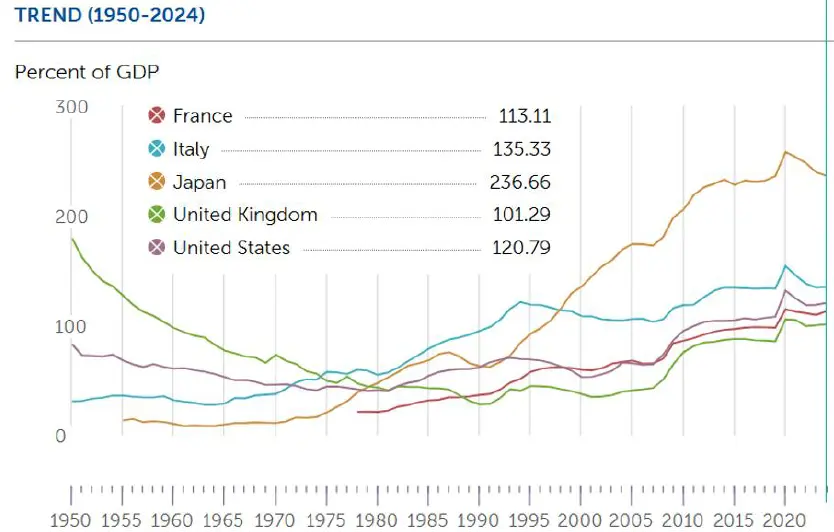
Source: IMF
What that means is that there’s no obvious place for investors to run to. If you’re worried about UK debt, you should also be nervous about France, or the US, or Japan. You could buy Chinese government bonds, but that feels quite risky too. That should avoid any panicked sell-off in government debt, though the grumbling is unlikely to stop.
Government borrowing is a genuine issue, but it’s also one that investors, economists and policymakers discuss daily. The existence of a problem doesn’t necessarily mean markets have mispriced it.
Also, it’s worth remembering that higher bond yields are not automatically bad news for investors. For the first time in many years, bonds once again offer meaningful income. And over the medium term, the best estimate for a bond’s return is the yield you buy it at. Add the tax advantages available on some UK gilts, and you’ll see some opportunities emerging from a planning perspective.
A world where investors are paid a reasonable return for lending money is not necessarily a world that should frighten long-term investors. It may even bring some spending discipline to governments that have been writing cheques their budgets struggle to cash.
How much inflation is coming?
After the inflation shock of recent years, many investors are wondering whether the problem has really gone away. The problem is that psychologically, once you worry about inflation, it takes a long time before you stop. Even though the cost of many things (computing, phones, cars) is cheaper than say, 10 years ago in real terms, it doesn’t stop the worry.
And moving into 2027, inflation is likely to come back in certain areas – in particular, food.
While the conflicts in the Middle East have a first-order impact on the price of oil and gas, those commodities are just as quick to respond to any easing. Open the Strait, the price falls.
But food is different. The lack of fertiliser supplies this summer will affect harvests right now. Hot weather linked to El Niño and climate change is likely to reduce agricultural output in 2027, raising food prices worldwide. With the UK harvest now largely complete, yields for most crops are well below the 10-year average.
| Crop | Harvest 2026: estimated UK average yield to date, t/ha | Historical yields: UK 10-year average, t/ha |
|---|---|---|
| Wheat | 6.9 | 7.9 |
| Winter barley | 6.9 | 6.9 |
| Spring barley | 4.8 | 5.7 |
| Winter oilseed rape | 4.0 | 3.3 |
| Oats | 4.6 | 5.4 |
Source: Agriculture and Horticulture Development Board (t/ha = tonnes per hectare)
And it’s food prices people notice most. Whether that’s in developed or emerging countries. As we saw in 2011 with the Arab Spring, popular discontent can have huge knock-on impacts. The good news is that any inflation surge will likely be less pronounced than in 2022, and that monetary policy is already being adjusted accordingly. While there’ll be more headlines about a “cost of living crisis”, it won’t truly be a crisis.
But it does show that inflation is becoming a more persistent concern. Supply shocks are back on investors' radar, and portfolios need to be prepared. Diversification remains the best defence, spread across regions and across businesses that both produce and consume commodities.
Donald Trump
Wars. Trade disputes. Political polarisation. Rising tensions between major powers. It’s not difficult to see why many investors feel the world has become more dangerous. And it’s not hard to tell a story where the blame sits with the man in the White House.
While it can be tempting to buy into the conspiracy theories of Trump finding a way to have a third term, we don’t think that’s going to happen. If he were widely loved by Americans, sure, anything’s possible. But the suggestion for the midterms is that the Republicans are going to lose everything.
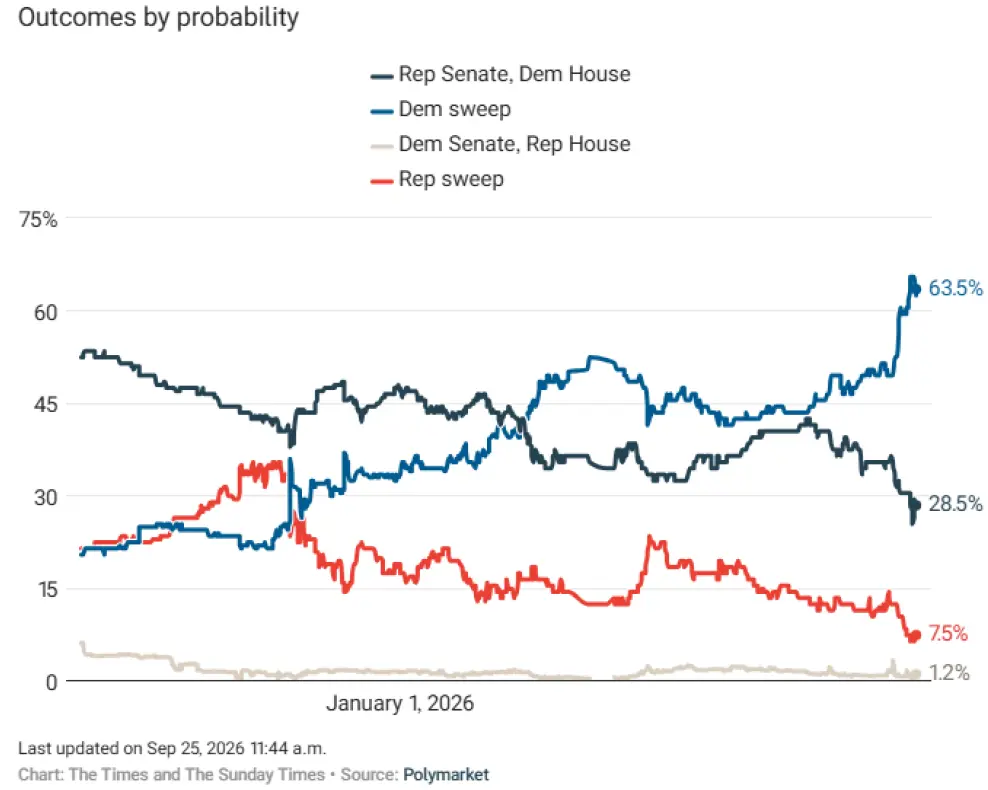
Which means a lame duck Donald Trump for the remainder of his term. More likely, it will lead to more controversial statements and reactive foreign policy, which may not do much for your heart rate. Sorry.
But it’s worth noting that businesses in the US are booming. And that whoever’s in the White House, the average annualised return of the S&P 500 is around 10%. Most of the time, companies don’t care about politics.
UK Budget
We’ve got good news and bad news: big changes look unlikely.
That's a concern because the UK needs structural reform to boost economic growth. Better infrastructure, a housing tax system that encourages people to move, and stronger incentives for entrepreneurs would all help. Difficult problems are usually best tackled sooner rather than later. Sadly, it's often easier to delay them.
That’s also good news, because it means some stability. We don’t have to adapt to yet another set of changes, particularly when we haven’t even implemented the stuff that’s been announced!
The government has started revealing some of its policies – and they’re small. Things like a help-to-buy iteration, but leaving social care for later on. It fits with the pattern of doing small things that are symbolic and don’t require intensive Office of National Statistics modelling.
Britain isn’t in as bad a place as the news suggests. Over the past three years, retail sales volumes have risen, household debt has fallen and economic growth has been positive (if small). Our companies look undervalued. Foreigners agree and continue to make bids to buy them. Let’s hope the bigger changes do come, but for now we’ll take “do no (more) harm”.
September markets wrap
September proved a challenging month for markets. Oil prices continued to be the root cause of poor market sentiment. The price of a barrel once again broke the $100 mark, as tensions in the Middle East continued to disrupt the flow of oil through key supply routes.
Central banks added to inflation concerns. Both the US Federal Reserve and the European Central Bank signalled that the fight against inflation is far from over. Interest rates have continued to rise in the US and Europe, with further increases expected before the end of the year.
Bond markets reacted negatively. US Treasury yields climbed to their highest levels since 2007. UK gilt yields also moved higher, even though the Bank of England chose to keep interest rates unchanged.
Equity markets had a more mixed experience. Rising bond yields weighed on investor sentiment, but strong corporate earnings and continued enthusiasm around AI helped limit losses. While market volatility increased, most equity markets proved resilient. Stronger economic growth and healthy company profits helped offset some of the pressure from higher bond yields.

Market movers
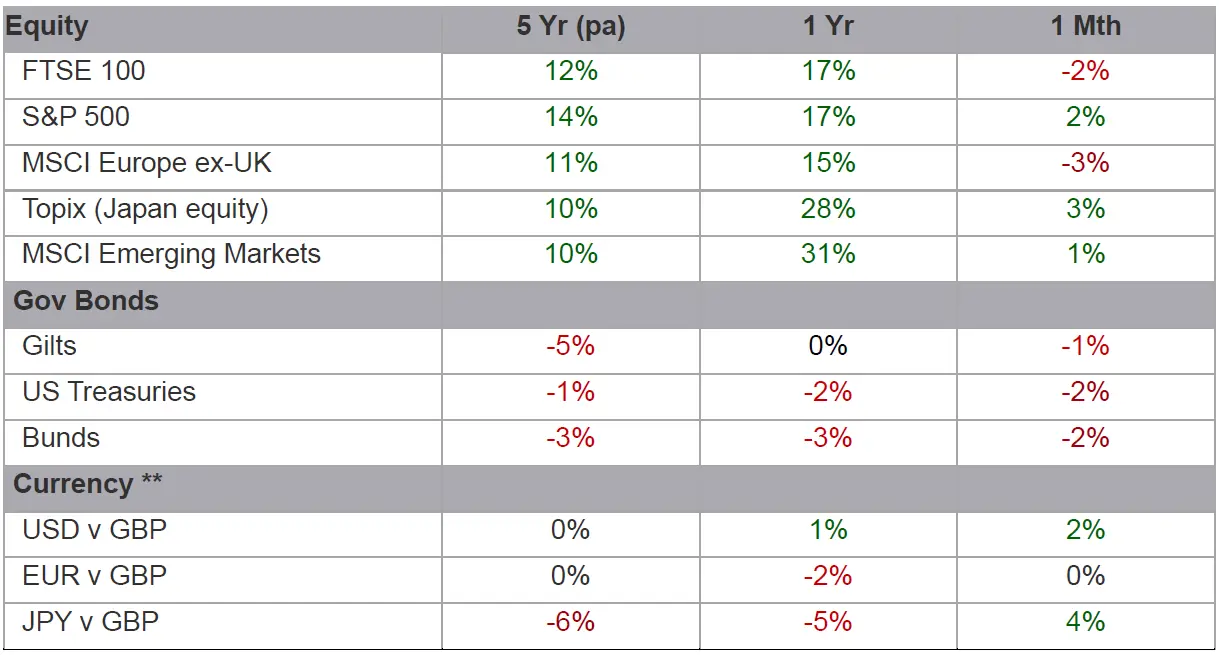
Source: Refinitiv. Quoted returns are in GBP for equities. Returns over 1 year are annualised. As at 30 September 2026. ** Currency returns are based on FX rates at midday London time
What we’re watching in October
- 14 October – Q4 earnings season gets going. Markets remain remarkably relaxed about AI spending; if the likes of Microsoft, Meta and Amazon are still writing enormous cheques for data centres, investors will want to know when the returns start showing up.
- 28 October – UK Budget. The UK’s problems are quite clear (high debt, high spending, minimal room for extra taxation). The answers less so. Will it be a strategic reset, or some light twiddling?
- 28 October – Federal Reserve monetary policy decision. After September's meeting, the question is whether Chair Warsh doubles down on inflation-fighting credibility. Thumbing your nose once at Donald Trump might be ok. But twice?
- 28 – 29 October: Alphabet, Microsoft, Meta, Apple and Amazon all report earnings.
More from 7IM




I confirm that I am a Financial Adviser, Solicitor or Accountant and authorised to conduct investment business.
If you do not meet this criteria then you must leave the website or select an appropriate audience.