

Is AI any good at UK financial advice?
We asked five free AI tools financial advice questions. Here’s what they got right and what they missed.
Most people don’t talk about money. Just 9% of UK adults have a financial adviser1. Friends and family may not fill the gap. Discussing salaries, savings and investments can still feel taboo.
AI offers another option. You can ask about money, pensions and tax without judgement.
We tested that idea by giving five well-known AI tools the same five UK financial planning questions, from a simple ISA query to a £3 million estate-planning challenge. We left out details such as age, marital status and income to see whether they would ask. We scored each first answer for accuracy, suitability, regulatory awareness, safety and transparency, with no follow-up chat.
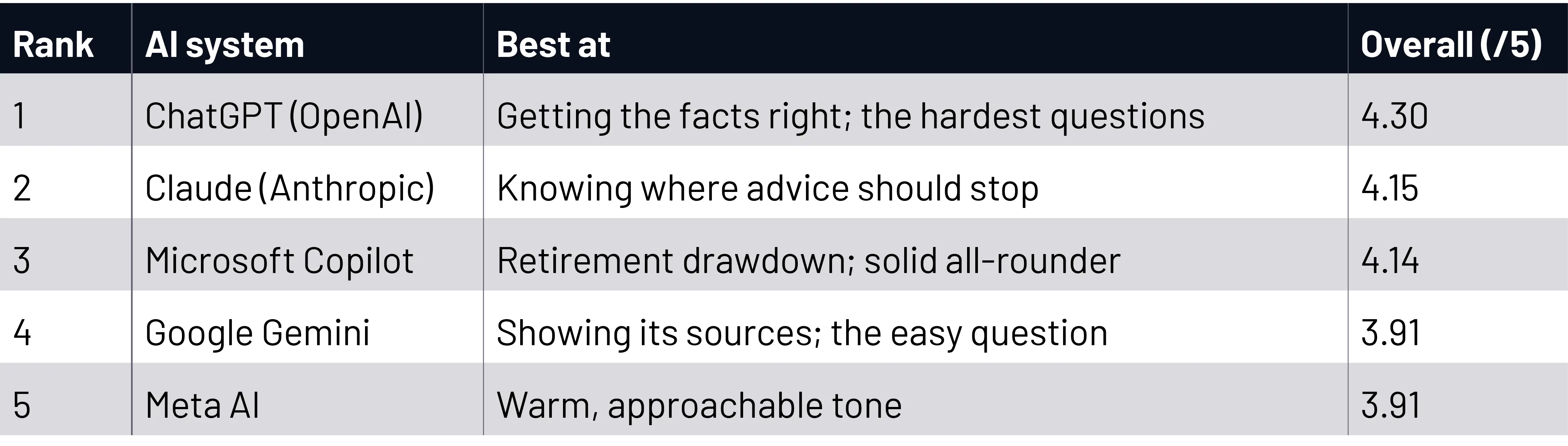
Weighted average across all five scenarios. Higher is better. These products change constantly, so this is a snapshot, not a permanent ranking.
Our verdict? They’re useful for learning, but they’re not a good substitute for a human adviser.
What they’re good at
AI is excellent at explaining. Ask how an ISA or pension tax relief works, and you’ll usually get a clear, jargon-light answer. Factual accuracy was the strongest area across the board.
The tools were also kinder than expected. In our bereavement scenario, a 62-year-old widow received a £400,000 insurance payout. Every tool responded sensitively. ChatGPT advised her not to rush, to watch for scams and to leave the pension alone until the tax position was clear. Meta AI offered support contacts.
The weak points
Facts that changed with little fanfare. Several tools told us savings are protected up to £85,000 per bank. That limit rose to £120,000 on 1 December 2025 but didn’t get much press. Only ChatGPT had it right. Likewise, most unused pension funds are due to be counted in your estate for inheritance tax from 6 April 2027 and not every tool flagged it. AI is reliable on changes as long as the internet is shouting about them.
Not personalised. Every tool pushed low-cost tracker funds. That’s a defensible starting point, but it’s also the safest thing an AI can say, largely because the internet is full of articles making that case. It isn’t a considered view of your situation.
Bad at challenging assumptions. If you ask how to cut inheritance tax by giving money away, you’ll get the gifting rules.
None of the tools asked whether you could afford to give the money away in the first place. Ask how to invest £300 a month for retirement and you’ll hear about accounts and funds, not whether £300 is anywhere near enough.
Cashflow modelling is the best way to test assumptions like these. It’s a method of checking whether your retirement income is likely to last a lifetime. Nearly every human adviser offers it. Only Claude mentioned it.
Complexity was underpriced. Where tools quoted costs for complex structures such as a family investment company, the figures were generally well below what we see in the real world. They tended to quote a set-up fee without the legal work, administration and ongoing upkeep that follows.
The harder the question, the wider the gap
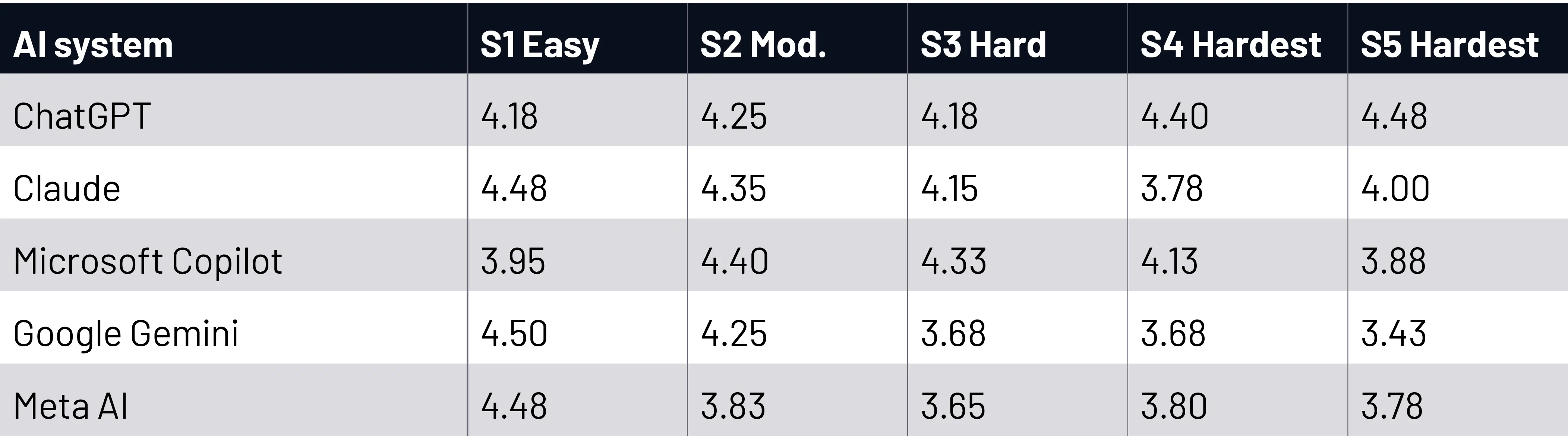
Weighted score per scenario. Scenarios four and five test vulnerability and complex tax planning.
On the easy ISA question, all five tools performed well and were hard to separate. On the toughest scenarios, the scores moved apart.
Only ChatGPT improved as the questions became harder. Gemini fell furthest, giving roughly the same length of answer to a simple ISA query and a complex retirement and estate-planning puzzle. That wasn’t enough to address the complications. Strong basics tell you little about how a tool will handle real life.
So, should you use it?
AI can explain facts clearly, but it doesn’t go deep enough. It can’t reliably exercise judgement: spotting the wrong question, testing an assumption or saying, ‘I need to know more.’
Even if AI gets there, the human part remains. Knowing what to do isn’t the hardest part of financial planning. Following a plan for 30 years is harder. That’s where we think human advisers are best placed. They can keep you on track and help you adjust as the world changes, and as you change.
This article is for information only and does not constitute financial advice. Scores reflect the specific AI products tested on a single date and may change as those products are updated.
1Financial Conduct Authority, June 2025

More from 7IM



I confirm that I am a Financial Adviser, Solicitor or Accountant and authorised to conduct investment business.
If you do not meet this criteria then you must leave the website or select an appropriate audience.