

The small-cap premium: Dead, dormant or due a revival?
A central pillar of investing is that taking more risk should mean more reward over the long term. But it does not always work that way. Markets are imperfect, and investors are not always rewarded for taking more risk within a timescale that makes sense. Smaller companies are a good recent example: many investors have taken the risk but not seen the reward.
Let’s first clear something up. While the phrase ‘small company’ might conjure up pictures of local builders or nail salons – that’s not what we’re talking about. The average size of a business in the MSCI World Small Cap Index is $2.8 billion!
But next to today’s trillion-dollar market giants, a couple of billion dollars is still quite small. That size gap makes them more exposed to downturns, changing customer habits and new technologies. Borrowing can be a problem, and reputations can disappear overnight. On the flipside, they have more room to grow, can be more agile, and can exploit new business models. Over the long term – the theory suggests – those advantages outweigh the drawbacks.
The long-term data supports the theory. In the period between 1928-2025, small-cap stocks outperformed large-cap stocks by roughly 1.5 percentage points annually.1 That might sound trivial, but over a lifetime, it’s the difference between an investment growing into £500,000 or £1 million. The numbers look good for the past 25 years as well.
But over the last decade, the rewards have dried up.
Small vs. Large Company Returns, 1999- present
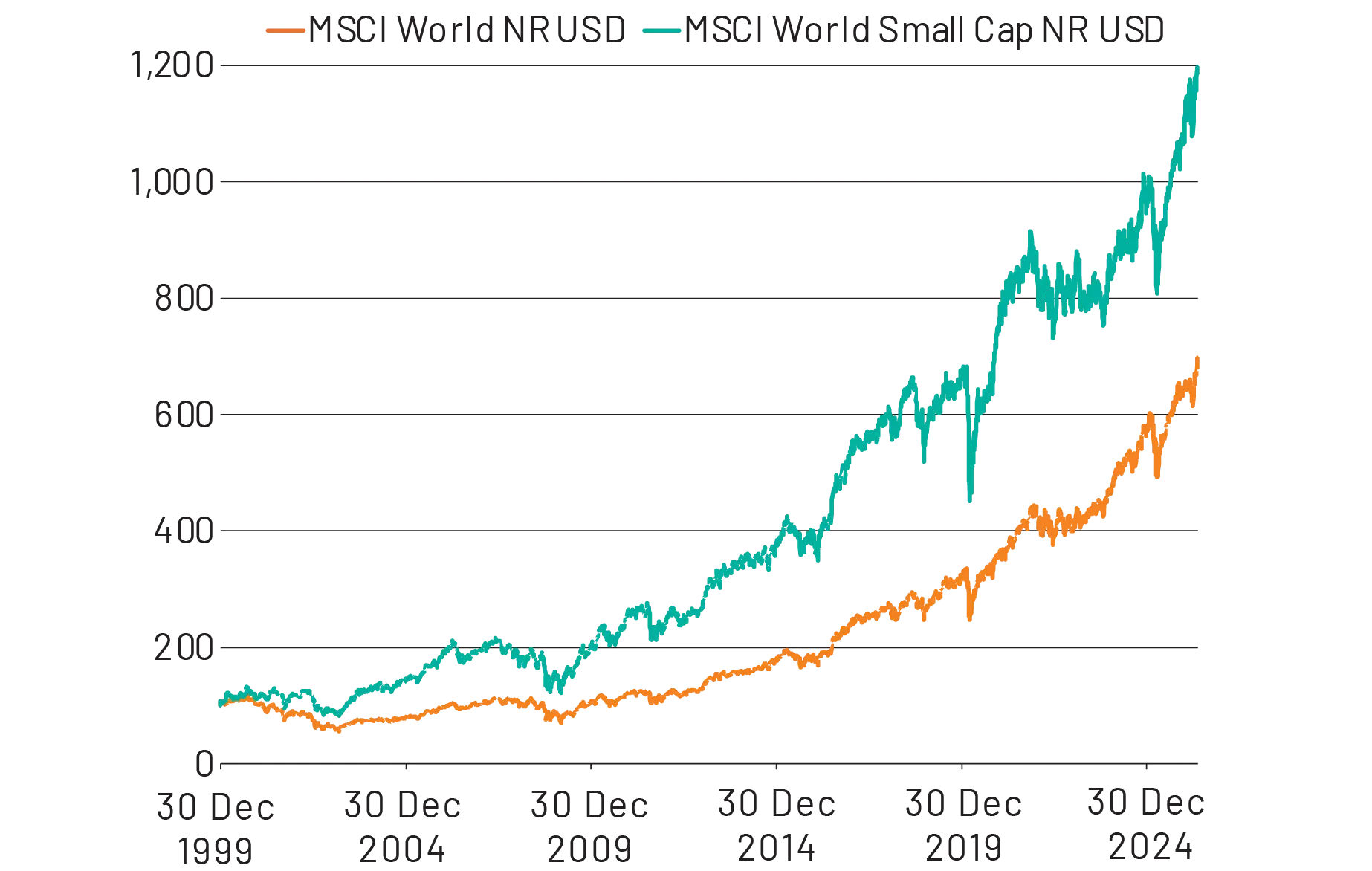
Source: Refinitiv. Uses MSCI World Small Cap NR USD and MSCI World NR USD indices.
Large companies have continued to grow, leaving small companies in their dust. The market heavyweights – technology companies like Nvidia, Apple, and Alphabet – have defied the laws of financial gravity, growing bigger each year.
Larger companies (as measured by the MSCI World index) have returned 269% over the last 10 years. In contrast, smaller company stocks (as measured by the MSCI World Small Cap index) returned just 192%. What’s changed in the past 10 years? Private equity and technology.
New companies have more choices for getting investment than they used to. The rise of venture capital and private equity allowed many companies to stay private for longer. When that happens, the fruits of their early growth go to private investors rather than smaller company shareholders.
Just six years after its founding, the giant semiconductor designer Nvidia listed on public markets in January 1999 with a value of $228.5m – it was a small, fast-growing company needing to raise more money, so it went public.
SpaceX was founded privately by Elon Musk in 2002, and stayed private until last month, when it listed with a value of $1.78tn. More money for private investors means less on offer for public investors.
Market Values at IPO
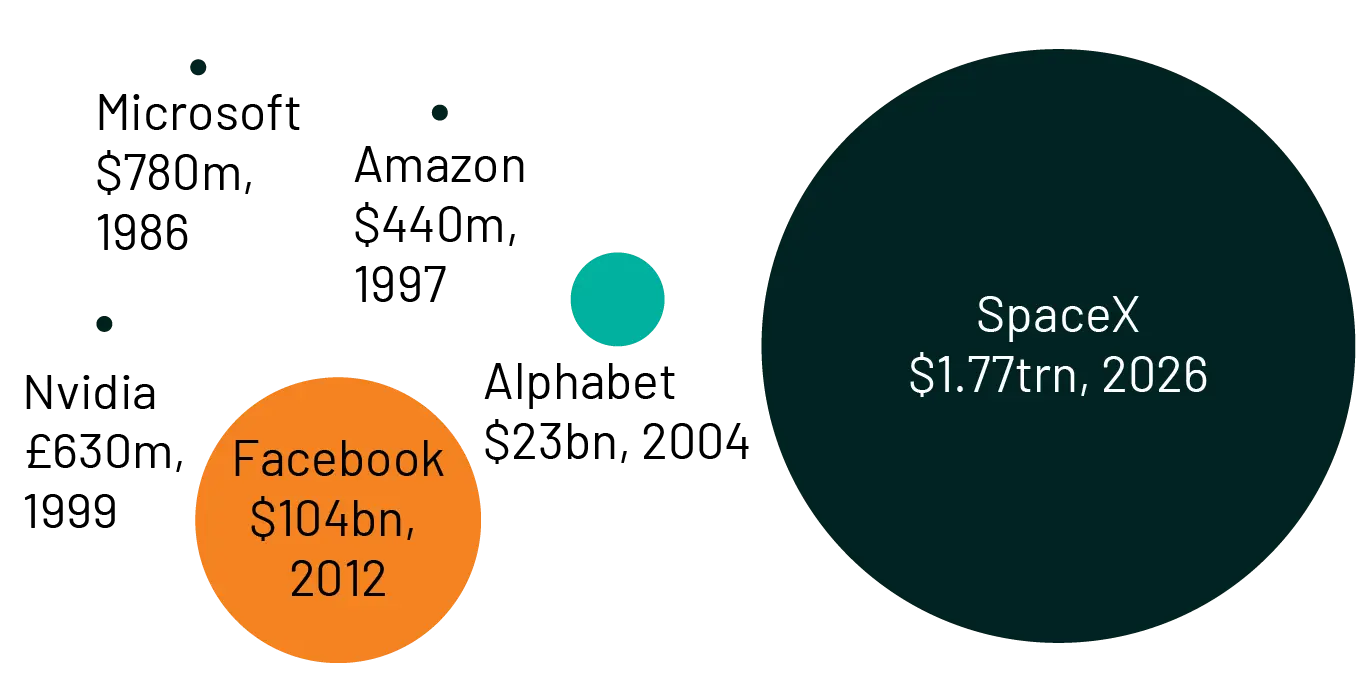
Source: Refinitiv. Figures shown are approximate equity valuations and are denominated in USD.
At the same time, large technology companies have exploited network effects: the bigger they get, the more useful they become. Social platforms are the obvious example. The more people join, the more valuable the platform becomes for everyone else. That makes it harder for rivals to compete – just ask MySpace.
Bigger companies can afford to invest billions, helping them get further ahead. We’ve also seen companies gobble up smaller rivals before they’ve had the chance to float and grow.
So, could smaller companies start outperforming again? Larger companies now look expensive. The valuation, as measured by looking at the cost of a share relative to the money they earn, is close to record highs. Valuations are not good at predicting shortterm returns but can be useful over longer periods (10 years+).
Meanwhile, small companies look cheaper. Yardeni data shows that small companies trade on 15.8 times expected earnings. Large companies trade on around 20.9 times. This is known as the forward price-to-earnings ratio. It compares a company’s share price with its expected earnings.
Technology may also start to erode the advantages of large companies. It used to take an army of high-paid computer programmers to create software. Now, AI can much of the heavy lifting.
Social platforms have also made it easier to tell millions about a new brand or product line. And it mightn’t cost anything if the message is catchy enough.
And in markets, there’s decades of evidence that smaller companies deliver higher revenue and earnings growth.
It isn’t a question of one or the other. We invest in both at 7IM because we believe in diversification. Not every company stays private until it’s worth hundreds of billions.
There’s a huge range of options within both small and large companies. Some are boring, some are speculative, some are expensive, some are cheap. Who knows, the next Nivida could be lingering in a small-cap index.
And it may well turn out that the decade of underperformance was the “higher risk” which delivers the better reward in the long term.

More from 7IM



I confirm that I am a Financial Adviser, Solicitor or Accountant and authorised to conduct investment business.
If you do not meet this criteria then you must leave the website or select an appropriate audience.